The Six-Week Window: Life and Afterlife on London’s Front Tables
On a grey Tuesday in Bloomsbury, a publisher’s rep wheels a suitcase into a bookshop and begins the quiet ritual that shapes what London reads next. Out come the proofs, the finished copies, the laminated sell sheets and the occasional tote bag. The manager nods, the buyer frowns, and somewhere near the door a front table is about to be rearranged. It looks like housekeeping. It is actually a small, ruthless piece of theatre.
The front table is the most valuable real estate in a bookshop. It is where a novel gets picked up by someone who came in for a birthday card. It is where a cookbook becomes an impulse buy and a memoir becomes a talking point. But it is also a clock. Every title placed face-out starts ticking, and booksellers across the capital will tell you the same thing: the window is shorter than most readers imagine.
First the rep, then the table
In independent shops, the front table is rarely a simple popularity contest. Buyers weigh publisher pitches against local taste, stock levels and the strange alchemy of what has been moving that week. A shop in Hackney might lean into translated fiction and political pamphlets; a Bloomsbury bookshop near the university may give more space to history and criticism; a Brixton shop with a strong events programme will make room for authors who can fill a room on a Thursday night.
‘You can feel when a book is going to work,’ says one buyer at a south London independent. ‘It is not always the one with the biggest campaign. Sometimes it is the one that customers keep asking for before you have even put it out.’
That instinct matters because the front table is not just display space. It is a signal. Face-out copies say: this is what we think you should notice. The moment a book is turned spine-out, moved to a section or stacked in a different part of the shop, the signal changes. It has not failed. It has simply entered a different phase of its life.
The face-out maths
The economics of the front table are blunt. A face-out copy takes up roughly three times the space of a spine-out one. If a shop has a six-foot table, it might hold forty or fifty titles at most. Every slot is a bet. Booksellers know that a front table can sell a title far beyond its natural rate, but only for as long as the book still looks fresh, relevant and conversation-worthy.
In the first week or two, a new hardback has momentum. It has reviews, perhaps a radio interview, a launch event, a wave of pre-orders and the curiosity that comes with anything newly published. By week three, the shop is watching the till rather than the publicity. By week four, the buyer is asking a very practical question: is this still earning its face-out spot, or is it time to let something else have a turn?
‘Six weeks is a good run for a lot of fiction,’ says a bookseller in Notting Hill. ‘Non-fiction can last longer if it is tied to a news moment or a season. Children’s books often have a much longer life because parents come back for the same titles. But for a general bestseller, the front table is not a permanent home. It is a shop window with a timer.’
Honeymoon, then the slow drift
The drift usually begins quietly. The book moves from the centre of the table to the edge. Then it is stacked with one or two others under a handwritten note. Then it is spine-out in the A–Z, or promoted to a ‘Staff Picks’ shelf, or tucked into a seasonal display. None of this is necessarily a demotion in the eyes of the shop. It is rotation.
‘People think we are constantly rejecting books,’ says a manager in Kingston. ‘We are not. We are curating a finite space. If a title has had four weeks face-out and is still selling steadily, it can go to a section and keep selling for months. The front table is for discovery. The shelves are for commitment.’
That distinction matters in a city where bookshops compete with screens, trains, pubs and each other. A front table has to do several jobs at once: catch the eye, signal the shop’s personality and shift stock. The books that last longest are not always the biggest sellers. They are the ones that keep being picked up, recommended and bought by people who did not know they wanted them.
The £5 trolley and the afterlife
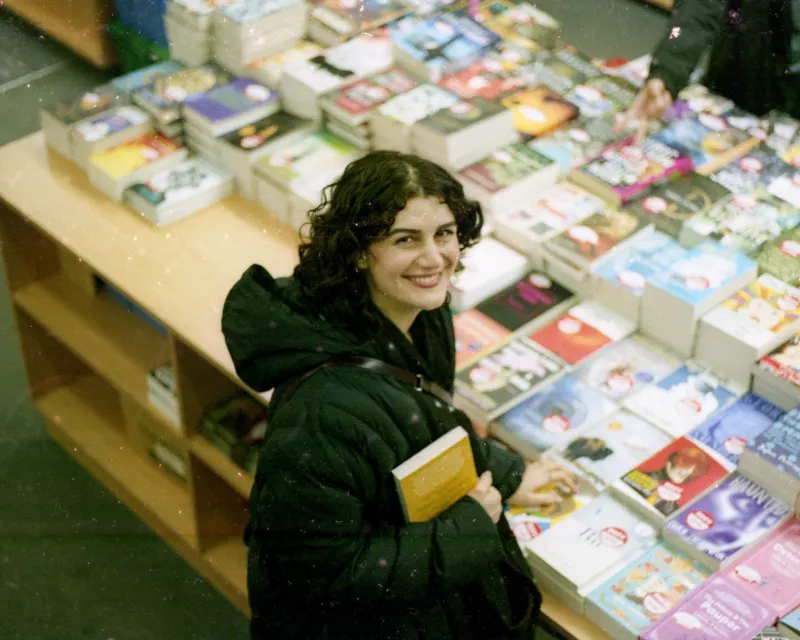
Then there is the trolley. The £5 table, the bargain cart, the cardboard box by the door — every London bookshop has its own version of the remaindered afterlife. It is easy to read this as failure, but the trolley is more complicated than that. It is where hardbacks become affordable, where backlist titles find new readers, and where a book that missed its moment on the front table gets a second, slower life.
A bookseller in Charing Cross Road puts it simply: ‘The front table is a sprint. The trolley is a long walk. Some books do better on the long walk.’
That is worth remembering the next time you see a familiar title reduced to a fiver. It has not necessarily been rejected. It has simply moved from the theatre of the new to the quieter business of the second-hand reader, the curious browser and the person who always checks the bargain table before heading upstairs.
The theatre of the table
The front table clock is not a perfect science. It is a mix of data, instinct, publisher pressure and the mood of the shop on any given morning. But it tells us something about London reading culture: we are drawn to the new, we are loyal to the familiar, and we are always willing to be surprised by a cover turned towards us.
So the next time you linger by a front table in Bloomsbury, Brixton or beyond, look at the faces. Some are in their first week. Some are in their last. All of them are part of a cycle that keeps the city’s bookshops alive — one face-out copy, one quiet rotation, one £5 trolley at a time.